Music Theory for Drummers: Rhythm Simplified
Ever sat down at a virtual drum set with tons of energy, only to feel like something’s just... off? You’re hitting the keys and making plenty of noise, but it doesn't quite feel like a real song yet. This is a super common hurdle for people who play drums online for the first time. You have the rhythm in your heart, but you’re missing the map to guide your hands.
Why does some music feel "right" while other beats feel messy? The answer is music theory. A lot of people think theory is just for piano players or classical composers, but that is a total myth. For a drummer, music theory is your secret language. It helps you understand exactly when to strike and, even more importantly, when to stay silent.
Let's demystify music theory together—it's simpler than you think! We are going to show you that rhythm notation isn't an intimidating barrier. Instead, it’s the best tool in your kit for becoming a pro-level musician. By the time you finish reading, you'll be creating grooves that sound like they came straight from a professional studio! Best of all, you can practice every single concept using our online drum kit without spending a dime on expensive gear.

Understanding the Foundation of Rhythm Notation
Think of rhythm notation as your drumming blueprint. It tells you which drum to hit and exactly how long to wait before the next strike. Without this map, drummers would have to memorize every single hit by ear. While that's possible, it makes learning complex songs incredibly difficult.
Many beginners feel a bit overwhelmed by sheet music. You see lines and dots and feel like you’re reading a foreign language. But here is the good news: drum notation is actually much simpler than melodic notation. We don't have to worry about pitches like C, D, or E. We only care about "what" and "when."
The Anatomy of a Drum Beat: Notes, Rests, and Time
At its core, every great drum beat is built on two things: sound and silence. In music theory, we call the sound "notes" and the silence "rests." A note tells you to play. A rest tells you to wait. Learning to value the silence is what really separates a beginner from a pro. If you play constantly without any rests, your music will just sound cluttered and noisy.
Most modern music uses a "Time Signature" called 4/4 time. Think of this as a box that holds four steady beats. You count it like this: "1, 2, 3, 4." Every time you reach four, the box is full, and you start a new one. This box is called a "measure" or a "bar." When you use our virtual drum set, you are almost always playing in this 4/4 structure.
The different parts of your drum kit have specific roles in this anatomy:
- The Bass Drum (Kick) usually lands on beats 1 and 3.
- The Snare Drum usually lands on beats 2 and 4.
- The Hi-Hat usually plays steady notes to keep the whole band on time.
Applying Notation to Virtual Drums: From Score to Practice
Once you’ve got the "1, 2, 3, 4" count down, it’s time to get your hands moving. On a traditional drum set, you use your feet for the kick and your hands for the snare and cymbals. On a computer, we use keyboard mapping. For example, on our platform, you might use the 'x' key for the kick and the 'j' key for the snare.
To apply notation to your practice, try this quick exercise:
- Open the virtual drums tool.
- Count out loud: "One, Two, Three, Four."
- On "One," press the 'x' key (Kick).
- On "Two," press the 'j' key (Snare).
- On "Three," press the 'x' key (Kick).
- On "Four," press the 'j' key (Snare).
That right there is a classic rock beat! By following this simple notation, you are already using music theory. You are organizing sounds in time. The "Show Key" feature on our site helps you see exactly which button connects to which part of the kit, making it much easier to bridge the gap between your brain and your fingers.
Mastering Subdivision: The Secret to Tight Drumming
If the 4/4 beat is the skeleton of a song, subdivision is the muscle. Subdivision is the act of breaking those four big beats into smaller, even pieces. This is the secret to "tight" drumming. When a drummer has good subdivision, they sound steady and professional. If your subdivision is weak, you’ll end up rushing or dragging the beat.
Think of a ruler. You have the inch marks, but between them, you have smaller lines for half-inches and quarter-inches. Subdivision works the exact same way. It allows you to play more interesting and complex patterns while still staying perfectly inside that 4/4 "box."
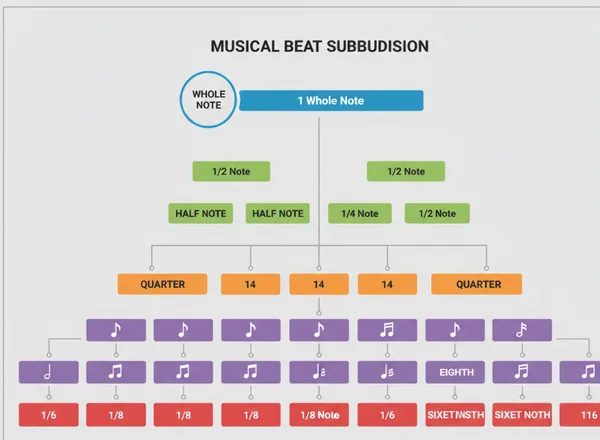
Dividing the Beat: From Whole Notes to Sixteenth Notes
In rhythm theory, we name notes based on how much of the measure they fill. Here is the basic hierarchy every drummer needs to know:
- Whole Notes: These last for all four beats. You hit the drum once and let it ring for the whole bar.
- Half Notes: These last for two beats. You hit on beat 1 and beat 3.
- Quarter Notes: These last for one beat. You hit on 1, 2, 3, and 4.
- Eighth Notes: These divide the beat into two. We count them as "1 and 2 and 3 and 4 and."
- Sixteenth Notes: These divide the beat into four. We count them as "1-e-and-a, 2-e-and-a..."
As you go down this list, the notes get faster. Most of the "groove" in modern music comes from eighth notes or sixteenth notes played on the hi-hat. If you want to play a fast hip-hop beat, you’re likely using sixteenth notes. If you’re playing a steady blues rhythm, you’ll probably stick to eighth notes.
Subdivision Exercises on Virtual Drums: Building Coordination
Practicing subdivision on a keyboard is a fantastic way to build hand coordination. Since you don't have to worry about the physical weight of a drumstick, you can focus entirely on your timing. This builds "muscle memory" in your brain that will transfer perfectly to a physical kit later.
Try this subdivision challenge:
- Set a steady pace in your head.
- Play quarter notes on the snare ('j' key) for four beats.
- Immediately switch to eighth notes (twice as fast) for four beats.
- Try to switch back and forth without losing the original speed of the beat.
You can practice drums online to see how consistent your timing really is. If you find yourself speeding up when you play faster notes, don't sweat it! That is a super common beginner mistake. The goal is to keep that "1, 2, 3, 4" pulse exactly the same, no matter how many smaller notes you pack in between.
Syncopation and Beyond: Advanced Rhythmic Concepts
Once you are comfortable with steady notes, it's time for the fun stuff. Steady beats are great for keeping time, but they can sometimes sound a little robotic. To make music feel "funky," "cool," or "surprising," we use advanced concepts like syncopation.
Syncopation is what gives music its "soul." It’s the reason you want to dance when you hear a great pop song. It involves playing with the listener's expectations by hitting drums where they don't expect them to land.

Playing Between the Beats: What Makes Syncopation Work
In a standard beat, we emphasize the "strong" beats (1 and 3). Syncopation happens when we emphasize the "weak" beats or the spaces in between them. For example, instead of hitting the kick drum right on beat 3, you might hit it just a tiny bit earlier—on the "and" of beat 2.
This creates a feeling of "forward motion." It makes the music feel like it is jumping ahead. Syncopation is the foundation of Jazz, Funk, Reggae, and Latin music. If you want to move beyond basic rock, you’ve got to learn to play "off the beat."
You can experiment with this using the hi-hat and crash on our tool. Try playing a steady beat but hitting an extra crash cymbal on the "and" of beat 4. It adds a dramatic flair to the end of your rhythm and makes the transition to the next measure feel much more exciting.
Creating Polyrhythms: Layering Multiple Time Signatures
Polyrhythms are one of the most advanced topics in drum theory. A polyrhythm occurs when you play two different rhythms at the exact same time. For example, your left hand might be playing a rhythm in groups of three, while your right hand is playing a rhythm in groups of two.
It might sound impossible, but it's really just a fun mathematical puzzle. The most common polyrhythm is "3 against 2." To the listener, this creates a complex, swirling sound that is very popular in African music and progressive rock.
Using a free drum tool is a safe, low-pressure way to explore polyrhythms. Since you are using your fingers on a keyboard, you can slowly map out which fingers need to press at the same time. It’s like a brain teaser for your hands! Start very slowly. Mastering polyrhythms takes time, but it makes you a much more versatile drummer.
Your Next Steps in Rhythmic Mastery
Music theory doesn't have to be a boring subject filled with dusty old books. For a drummer, it is a living, breathing tool that makes your playing more expressive and professional. By understanding notation, mastering subdivision, and exploring syncopation, you are giving yourself the freedom to create any rhythm you can imagine.
Here are the three game-changing concepts to take away from this:
- Notation is your map; it tells you where to go.
- Subdivision is your clock; it keeps you steady.
- Syncopation is your personality; it makes the music dance.
The best way to learn these concepts is through hands-on experience. You don't need a room full of drums to start your journey. You can apply everything you learned today right now. Head over to the homepage and start drumming now to put these theories into practice. The more you play, the more these concepts will feel like second nature!
Frequently Asked Questions About Rhythm Theory for Drummers
Can I learn to read drum notation without formal music education?
Absolutely! Drum notation is very visual. Unlike piano music, which requires you to learn many different notes on a staff, drum notation usually focuses on a few key positions for the kick, snare, and cymbals. Using an online drum kit helps you see the link between keys and sounds. This makes learning notation much faster!
How does understanding music theory help me play better on Virtual Drums?
Music theory helps you understand the "why" behind the buttons you are pressing. Instead of just randomly hitting keys, theory allows you to build structured loops and beats. This makes your practice sessions more productive and helps you recreate your favorite songs with much higher accuracy.
What's the most important rhythm concept for beginners to master?
The most important concept is subdivision. If you can't keep a steady eighth-note or quarter-note pulse, even the most complex fills will sound messy. We always recommend that beginners focus on playing a simple 4/4 rock beat with perfect timing before trying to learn advanced solos.
How can I practice polyrhythms on a virtual drum set?
The best way is to start with "2 against 3." Set a slow internal metronome. Use one finger on your left hand to hit the snare on every second beat, and use a finger on your right hand to hit the hi-hat on every third beat. It will feel strange at first, but our virtual drum tool allows you to practice this silently as many times as you need to get it right.