Create Your First Drum Solo Online
Ever find yourself tapping at your desk, dreaming of a massive drum kit? We’ve all been there. Heart-pounding solos are the goal, but gear costs and loud neighbors often kill the vibe. Crank up your creative flow – we’ll transform those desk-tapping habits into legit drum skills before your coffee cools.
No drumsticks? No problem. Whether you're air-drumming to your commute playlist or prepping for a garage band audition, you can turn your computer into a high-quality percussion station. By using an online drum kit, you can start practicing rhythms immediately. In this guide, we will show you how to move from simple tapping to creating your very own drum solo using nothing but your keyboard.
Building confidence and skill is the focus here. You will learn to organize your thoughts and master keyboard controls. By the end of this journey, you will perform a drum solo online that sounds professional and polished.
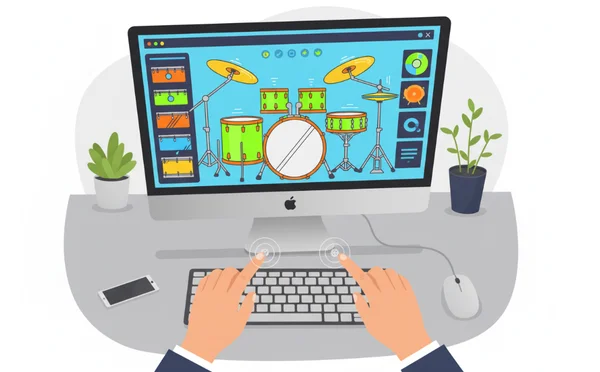
From Desk Taps to Drum Solos: Your Virtual Journey Begins
Improvisation means making music spontaneously – a daunting prospect for new drummers. Will you strike the wrong drum? Lose the beat? With visual cues from our virtual kit, these fears fade fast. The "keyboard drum improvisation" process becomes manageable because your tools sit right in front of you.
On our virtual drum platform, every key on your keyboard is mapped to a specific part of the drum set. For example, your 'X' key might control the bass drum. The 'Space' bar or 'J' key triggers the snare. The first step in improvisation is becoming comfortable with these mappings. Spend a few minutes hitting different keys. Listen to the crisp, realistic sounds of the crash cymbals, toms, and hi-hats.
Building Your Solo Foundation
Every great solo starts with a solid foundation. You cannot build a house without a floor. Likewise, you cannot build a solo without a "home base" beat. In drumming, this usually involves the bass drum and the snare. This anchor keeps the listener grounded while you explore wilder rhythms.
To start, try to maintain a steady pulse. Hit the bass drum on beats one and three. Strike the snare on beats two and four. This is the classic "heartbeat" of rock and pop music. Once you feel this pulse in your body, you have established your solo foundation.
From here, you can start to experiment. Try adding a quick double-tap on the bass drum. Perhaps add a light tap on the hi-hat between snare hits. If you want to play virtual drums effectively, you must learn to keep this internal clock ticking. The clock must stay steady even when you get creative with other parts of the kit.
Essential Rhythmic Patterns for Solos
Once you have your foundation, it is time to introduce rhythmic patterns. Patterns are the "words" in your musical sentences. Instead of just hitting drums randomly, you want to use recognizable sequences. These sequences catch the listener's ear and give your performance a sense of purpose.
One of the most effective patterns for a virtual solo is the "triplet." A triplet fits three notes into the space where two would normally go. On a keyboard, this feels like a quick 1-2-3, 1-2-3 motion across different keys. You can also experiment with "syncopation." This means hitting notes on the "off-beat"—the silent spaces between the main pulses. It acts like a rhythmic hiccup that keeps the energy high.
Try this simple exercise:
- Play four steady beats on the bass drum.
- In the space between each bass drum hit, tap the snare twice quickly.
- On the fourth beat, hit the crash cymbal (the 'Y' key) to finish the phrase.
By repeating and slightly changing these patterns, you begin to master the art of online drumming.
Drum Solo Structure Practice
A solo isn't just a long string of random fast notes; it is a story. It has a beginning, a middle, and an end. When you engage in "drum solo structure practice," you are learning how to take your audience on a journey. Without structure, a solo can feel like a run-on sentence.
Think of your solo in three parts:
- The Introduction: You start with a simple theme or beat to get people interested.
- The Development: You make the rhythms more complex, louder, and faster.
- The Climax and Conclusion: You reach a peak of energy and then finish with a satisfying final hit.
Using an online tool allows you to record your thoughts. You can repeat sections until they feel right. This structured approach prevents you from "running out of ideas" halfway through your performance.
Adding Dynamics and Expression
In music, "dynamics" refers to how loud or soft a sound is. If every note in your solo is at the same volume, it will sound robotic. To make your virtual solo feel alive, you need to focus on expression.
Keyboards lack genuine pressure sensitivity. But clever drummers fake dynamics! Vary your timing and note spacing to mimic real stick control. "Ghost notes" become secret weapons here. These are very quiet, subtle hits on the snare that fill in the gaps between the main beats. By adding these light taps, you give your drumming a professional, "swinging" feel.
Another way to add expression is to vary your speed. Start your solo slowly and gradually increase the tempo. This builds tension and excitement. It makes your final crash cymbal hit feel much more powerful. You can test your skills by trying to maintain a very quiet, steady rhythm for thirty seconds before exploding into a loud section.

Creative Transitions Between Sections
One of the hardest parts of drumming is moving smoothly from one idea to the next. These are called transitions. If your transition is messy, the solo loses its flow. You want the listener to feel the evolution of the beat, not a sudden jar in the rhythm.
A great way to transition is by using "fills." A drum fill is a short break in the main rhythm where you move across the toms and cymbals. On your keyboard, this might look like a quick slide of your fingers across the top row of keys.
To practice creative transitions, try the "Question and Answer" technique:
- The Question: Play a short rhythm on the snare and hi-hat.
- The Answer: Respond to that rhythm with a quick roll across the high tom, mid tom, and floor tom.
This creates a logical link between different parts of your solo. If you find yourself getting stuck, you can always use our tool to find new sounds or mappings. These different sounds can inspire a different movement and refresh your creative perspective.
Ready to Make Some Noise?
Ready to make some noise? Crafting your debut drum solo is equal parts thrilling and accessible. You don't need a soundproof room or thousands of dollars in gear to express your rhythmic creativity. By mastering the keyboard layout and building a solid foundation, you develop real musical talent.
The most important thing to remember is that drumming is about joy. Don't worry about being perfect on your first try. Every professional drummer started by hitting things and making "mistakes." With the virtual tools available today, those mistakes don't cost anything. Better yet, they don't wake up the neighbors.
Now that you have the framework for your solo, it is time to put it into practice. Head over to the homepage and start your solo right now. See how many different rhythms you can create and discover the drummer waiting inside you!
FAQ: Keyboard Drum Solo Essentials
How to play drums on a computer keyboard for solos?
Playing a solo on a keyboard requires you to treat your fingers like drumsticks. Each key is mapped to a different drum part like the Bass, Snare, or Cymbals. To perform a solo, use both hands to create alternating patterns. Most users find it easiest to use the 'X' and 'C' keys for the bass. Use the 'J' or 'Space' keys for the snare. You can see the mappings by clicking the "Show Key" button on the interface.
Can you learn drums online effectively?
Yes! You won't get the physical muscle memory of holding actual sticks immediately. However, you will learn the most critical part of drumming: rhythm and coordination. Online tools help you understand beat structures and timing. You learn how different drums sound together. It is an excellent, low-pressure way to begin your journey before committing to a physical kit.
How to practice drum fills without a drum set?
You can practice drum fills by using the "linear" movement of your keyboard. Most virtual kits map the toms and cymbals across a horizontal line. Practice moving your fingers in a "rolling" motion from left to right. This mimics the movement of a drummer moving from the high tom to the floor tom. Using an online simulator allows you to hear the pitch change as you move across the kit. This is essential for developing a musical ear for fills.